
E4 Western Part of Crete
- Orestis Nielsen
- May 1, 2025
- 5 min read

Crete has always held a mysterious pull on me—the rugged terrain, the endless blue coastline, and the depth of its tradition seem to speak from the very soil. To fully embrace that essence, I decided to run and hike part of the Western E4 trail, a route that crosses some of the island’s most dramatic and untouched landscapes.
Over five intense days, I covered more than 260 kilometers, climbing over 11,000 meters from Kissamos to Kamares. I ran through remote beaches, lonely ridgelines, and ancient villages. It was physically brutal, often psychologically draining, and yet—beyond all expectation—profoundly transformative.
To stay safe during this solo trip, I relied on a Garmin GPS tracker, set to ping my location every 30 minutes to my contacts—mainly my parents. This device became essential not just for safety but for peace of mind. My family also joined me on four of the five days, appearing at key checkpoints and bringing much-needed encouragement. My dad, especially, played a significant role—hiking several segments with me, including parts of the Psiloritis climb and the breathtaking section from Agia Roumeli to Hora Sfakion.

Day 1: Kissamos to Sougia
The journey began on Friday, May 11, under a bright sky in Kissamos. My pack weighed 6–7 kg, and my legs were fresh with anticipation. The trail meandered through Vathi, Pervolia, and Marouliana, hugging hills and coastlines as I pushed forward under a relentless sun.
By the time I reached Elafonisi Beach (km 43), I was already aching, but the turquoise water and pink sands offered a brief emotional reset. The following stretch to Palaiochora took me along rugged coastline, past hidden beaches and towering cliffs. It was one of the most beautiful sections of the trail—a moving meditation of sea and stone.
Arriving in Palaiochora around 8:00 PM, I debated stopping. But momentum pushed me forward. The next 13 kilometers to Sougia, mostly in darkness, tested everything I had. My knees screamed on steep climbs, and the final gorge section felt like an ancient canyon swallowing time itself.
At 11:30 PM, I collapsed into a beach bar, asked for ice, and eventually found a place to lay down near the sand. I called my parents, unsure if I could continue. They encouraged me to rest, recover, and reassess. I drifted to sleep uncertain but committed.

Day 2: Sougia to Hora Sfakion
This day turned out to be the hardest—my knees still throbbed from the previous day, and the terrain between Sougia and Hora Sfakion was nothing short of punishing. The trail was a series of endless ups and downs, winding over rocks and narrow ledges that never seemed to end.
I met my dad near Loutro, and we tackled the final 20 kilometers together. Hiking under the stars with him was both grounding and surreal. We reached Hora Sfakion at 1:00 AM, where I finally had a hot meal. I rolled out my mat on the port’s wavebreaker and slept under the open sky.
At 5:30 AM, light rain woke me. I took cover in the hotel lobby where my parents were staying and prepped for the next leg.

Day 3: Hora Sfakion to Argyroupoli
I passed through Imbros Gorge, crowded with tourists—an unusual contrast to the solitude I’d come to appreciate. The trail climbed to Kallikratis, where I saw a few scattered homes and a family living quietly in the village. There was a boy my age, and I couldn’t help but admire their choice to remain in such a remote, grounded place. It gave me pause—a glimpse into a different kind of life.
The descent into Asi Gonia was steep and unforgiving. I reunited with my parents at 7:00 PM and continued with my dad to Argyroupoli, though we took a wrong turn and ended up wandering through a farm. It became a pleasant detour—an unexpected adventure before reaching the village and enjoying dinner at a warm taverna. That night, I slept in a real bed and felt human again.
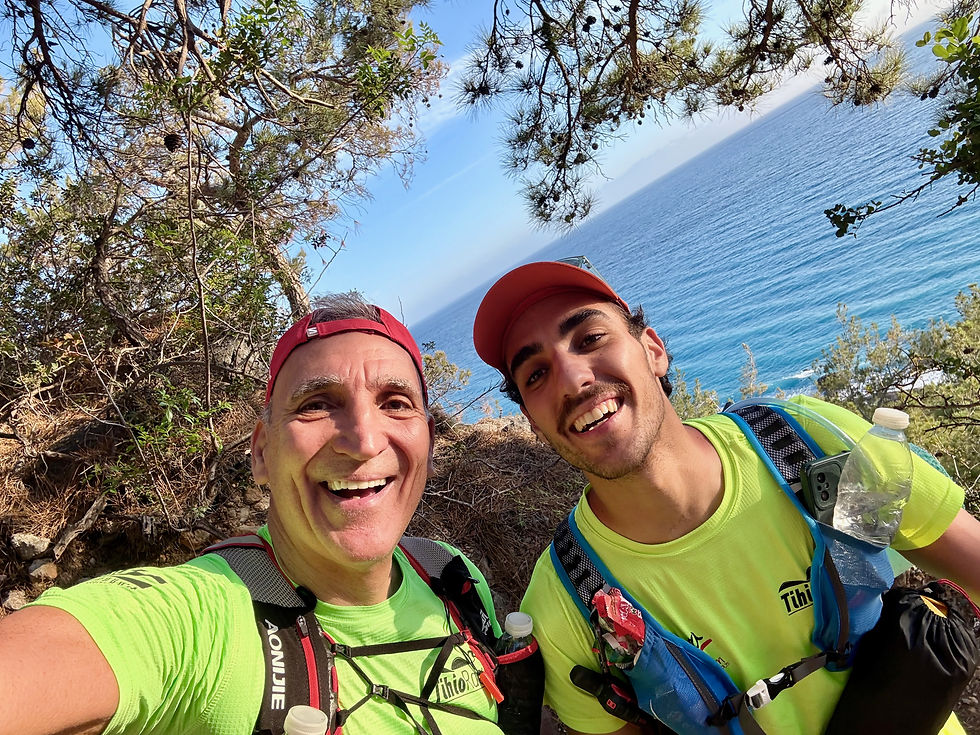
Day 4: Argyroupoli to Fourfouras
Refreshed, I left Argyroupoli at 6:00 AM. The first 21 kilometers flew by—I ran like the wind to Agkouseliana and then to Spili, where I joined my parents for breakfast. But from that point on, the route got rough.
My ankle began swelling, and trail navigation became a challenge. I got lost more than once, especially near Gerakaki, where I eventually abandoned the trail and “straight-lined” down a slope—dangerous but oddly exhilarating.
Beyond Elenes, the path became completely overgrown. I was scratched up, bleeding, and limping, but I kept going. In this pain and silence, something shifted inside me.

Day 5: Fourfouras to Kamares via Psiloritis
I woke at 5:00 AM, exhausted and silent. My dad and I began the climb toward Psiloritis, and for the first few hours, I didn’t speak. But as the sun rose between mountain ridges, something awakened. The scenery was otherworldly, and soon conversation and laughter returned.
The climb was steep and icy. We had to traverse snowy ridgelines, focusing with every step. After 5.5 hours, we reached the summit—cold, windy, and breathtaking. From the peak, I could see across Crete, and beyond that, the horizon stretched forever. I felt incredibly small, yet deeply connected to something much greater.
On the way down to Nida Plateau, we moved cautiously over snow-covered paths. My mom met us there and picked up my dad.
I still had 13 kilometers of road to reach Kamares. Alone again, I began running. Something inside me snapped open. For the first time in five days, I put on music and began singing aloud. Tears streamed down my face. I was overwhelmed—not by pain, but by joy, release, and awe. Everything I had endured crystalized into this euphoric final stretch. It felt almost sacred.

This journey wasn't just about distance—it was a battle between my body, my mind, and the environment around me. There were moments of deep physical struggle, but also moments of awe that overwhelmed me—especially in nature. Watching the sun rise over mountain ridges or witnessing the sea melt into the horizon filled me with a sense of wonder that often became my strongest motivator.
Solitude became a profound presence. Alone in wild landscapes, I found unexpected peace. The quietness of remote gorges, the chirping of birds, and the crackle of dry brush underfoot brought on emotions I hadn’t anticipated. At times, the beauty was so intense I felt on the verge of tears.
By the end of day four, I realized something essential: I had to approach nature with humility. The terrain didn’t care about my pace or goals. Accepting that brought a strange freedom. I began to see each challenge not as an obstacle, but as something sacred—something to respect.
Pain was constant—swollen knees, a bruised ankle, cuts lining my legs. But instead of resisting, I allowed the pain to wash over me, until my mind quieted and my body became a vessel moving through the world. I entered what I can only describe as the “pain cave.” In that space, I let go of resistance and just moved, present in every moment.

Running across the western spine of Crete along the E4 was more than a physical feat—it was a journey into myself. I faced isolation, exhaustion, and fear. But I also found peace, beauty, and a deep sense of presence.
This island doesn't just ask you to move through it—it demands that you feel it, respect it, and open yourself to its lessons. And if you do, it gives something back: a sense of reverence, clarity, and connection that stays with you long after the trail ends.


Comments